
Part IV: Dr. Judah Folkman — A World Without Him
If the idea of angiogenesis had been filtered out before it ever reached a patient, what exactly would be missing from medicine today? More than one drug. A whole way of understanding cancer.

Across this series, we’ve established two things. First, how nearly the angiogenesis story didn’t happen — three decades of ridicule, lost grants, and a surgeon who survived on stubbornness and a clinical income. Second, how much harder those conditions would be to reproduce in the research climate of 2026, where the system has grown impatient with exactly the kind of long-horizon, against-consensus bet his idea represented. So let’s run the counterfactual directly:
Suppose the idea had been filtered out — suppose a younger Folkman, without tenure-grade stubbornness or a surgeon’s income to fall back on, had simply moved on when the grants dried up, and no one picked up the thread. Where would oncology be?
Start with what one lab produced
Before we count what’s missing downstream, look at what a single sustained grant line generated upstream. Folkman’s lab didn’t produce one discovery. Over twenty-five years, it produced a column of them:
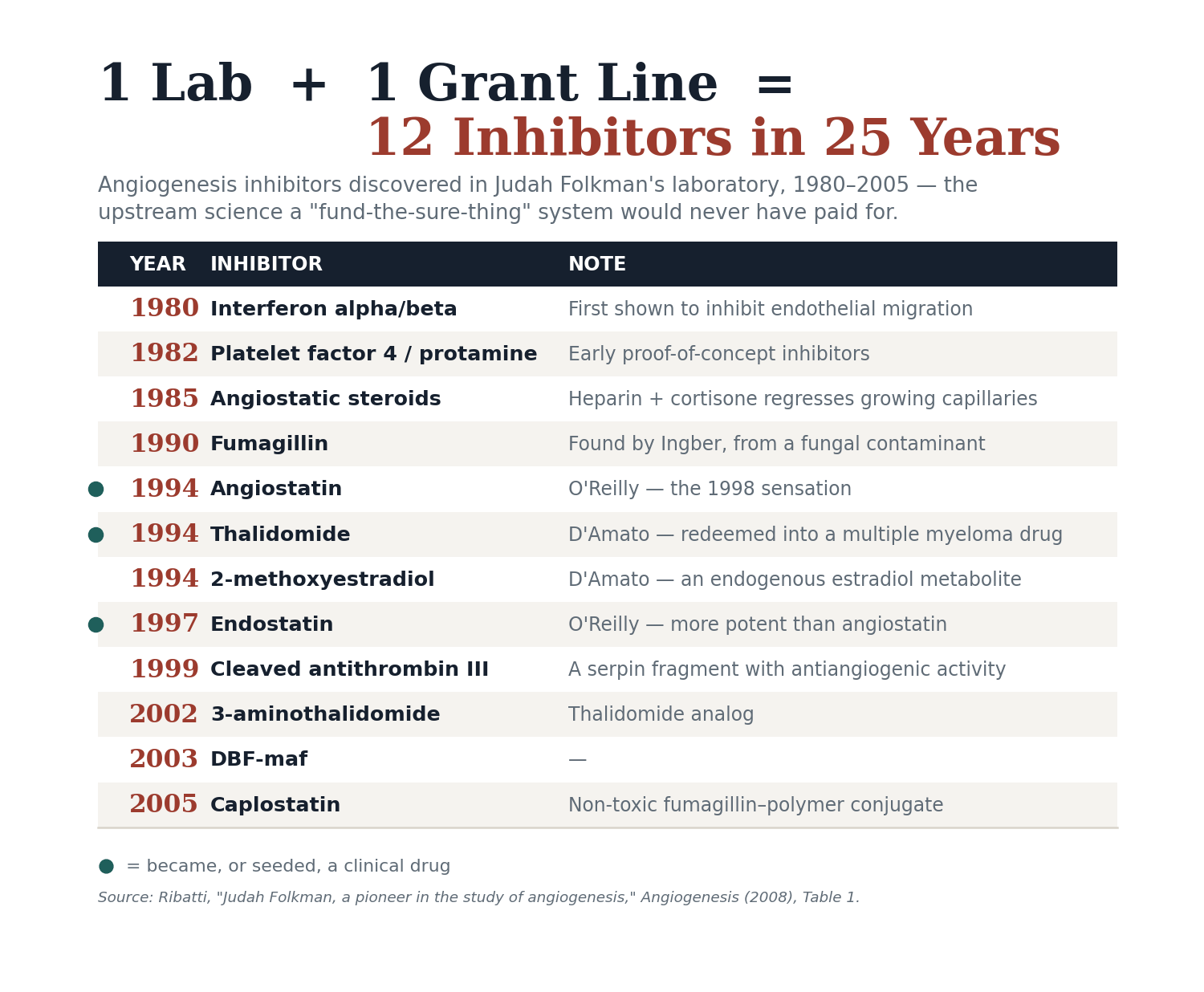
That entire table is what “filtering out the long shot” would have erased — and the table is only the upstream science. The downstream absence is bigger still.
What goes missing
An entire drug class wouldn’t exist as we know it. Bevacizumab and the VEGF-targeting agents that followed — across colon, lung, kidney, cervical, ovarian, and brain cancers — descend directly from the framework Folkman built. Remove the framework and you don’t just lose Avastin; you lose the category, and the decades of combination regimens built around it.
Millions of people with macular degeneration might still be going blind. One of antiangiogenesis’s largest real-world victories came outside cancer entirely: the same anti-VEGF logic became the standard treatment for wet age-related macular degeneration. That whole branch of ophthalmology traces back to a cancer surgeon’s rejected hypothesis — the clearest possible illustration of why you can’t predict the payoff of basic research in advance.
Thalidomide stays a cautionary tale instead of becoming a myeloma drug. D’Amato’s angiogenesis insight is what redeemed one of medicine’s most notorious compounds into a genuine treatment for blood cancer.
We’d understand cancer itself less well. “Inducing angiogenesis” is now taught as one of the core hallmarks of cancer — a foundational organizing principle. Without Folkman, a whole dimension of how we conceptualize the disease is dimmer: tumor dormancy, the tumor microenvironment, the idea of starving a cancer rather than only poisoning it.
Oncology wouldn’t have stopped. Surgery, radiation, chemotherapy, and later immunotherapy and targeted small molecules would still have advanced. But it would be a narrower, blunter field, missing one of its central pillars — and the patients who got years from these drugs, or kept their eyesight, would have gotten neither.
The point
The lesson of Folkman isn’t “fund everything.” It’s that the discoveries that most reshape medicine often look, in the moment, exactly like the ones a return-on-investment screen is built to reject: against consensus, from the wrong specialty, promising payoffs decades out, easy to mock. The peer-review system’s job is to place some of those bets anyway, and to be patient enough to let a few of them ripen over thirty years.
The AI tools arriving now are genuinely thrilling, and they may dramatically compress that timeline. But they compress development. They are engines that run on validated targets and rich data — both of which come from exactly the slow, curiosity-driven, publicly funded science we spent 2025 and 2026 hollowing out. An AI that can design a molecule against VEGF is worthless until some stubborn human, working for years on an idea his peers hated, first discovers that VEGF is worth aiming at.
We are currently running the Folkman Test in reverse: building extraordinary tools to act on insights while defunding the system that produces them. The bill for that won’t arrive next quarter. It will arrive in the 2050s, in the breakthroughs that quietly never happened — the fields that were never founded, because the heretic who would have founded them couldn’t get the grant.
I started this series in St. Catherine’s Park in 1998, laughing at a story about mouse urine that turned out to be one of the most important ideas in modern medicine. The thing worth remembering is that it almost didn’t happen — and that the conditions which nearly stopped it are precisely the ones we’re now rebuilding on purpose.
I have authored and edited this article. AI has been used to assist with background research and formatting. Sources include the Ribatti (Angiogenesis, 2008), PNAS, and Cell retrospectives on Folkman’s career, along with reporting from The ASCO Post, OncLive, and STAT News. This is the final part of a four-part series on Dr. Judah Folkman and the research system that nearly stopped him.